Retirement Planning for High Earners in Their 30s and 40s
If you're in your 30s or 40s and earning a strong income, retirement probably doesn't feel urgent. It's decades away, your career is on the rise, and there's a mortgage, kids, or a business to think about right now. But this decade is exactly when the biggest opportunities in retirement planning show up (and also when the most expensive mistakes get made).

High earners face a different set of rules than the average saver. Once your income climbs past certain thresholds, some of the "just max out your 401(k)" advice stops being enough, and a few of the simplest strategies (like contributing directly to a Roth IRA) may not even be available to you. Let's break down what retirement planning actually looks like at this income level, in plain English.
Why Retirement Planning Looks Different for High Earners
The core idea of retirement planning is the same for everyone: save consistently, invest for growth, and manage taxes along the way. What changes for high earners is the number of tools available and how those tools interact.
If you work in oil & gas, energy, engineering, or another high-earning corporate career, your compensation package is often more complex, too. Base salary plus bonus, employer stock, deferred compensation, or a mix of all three. That complexity is actually an opportunity. More moving pieces means more places to be intentional about taxes, timing, and where your money ends up.
The 2026 Numbers You Should Know
Contribution limits are set by the IRS and adjusted most years. Here's a snapshot of where things stand for 2026:
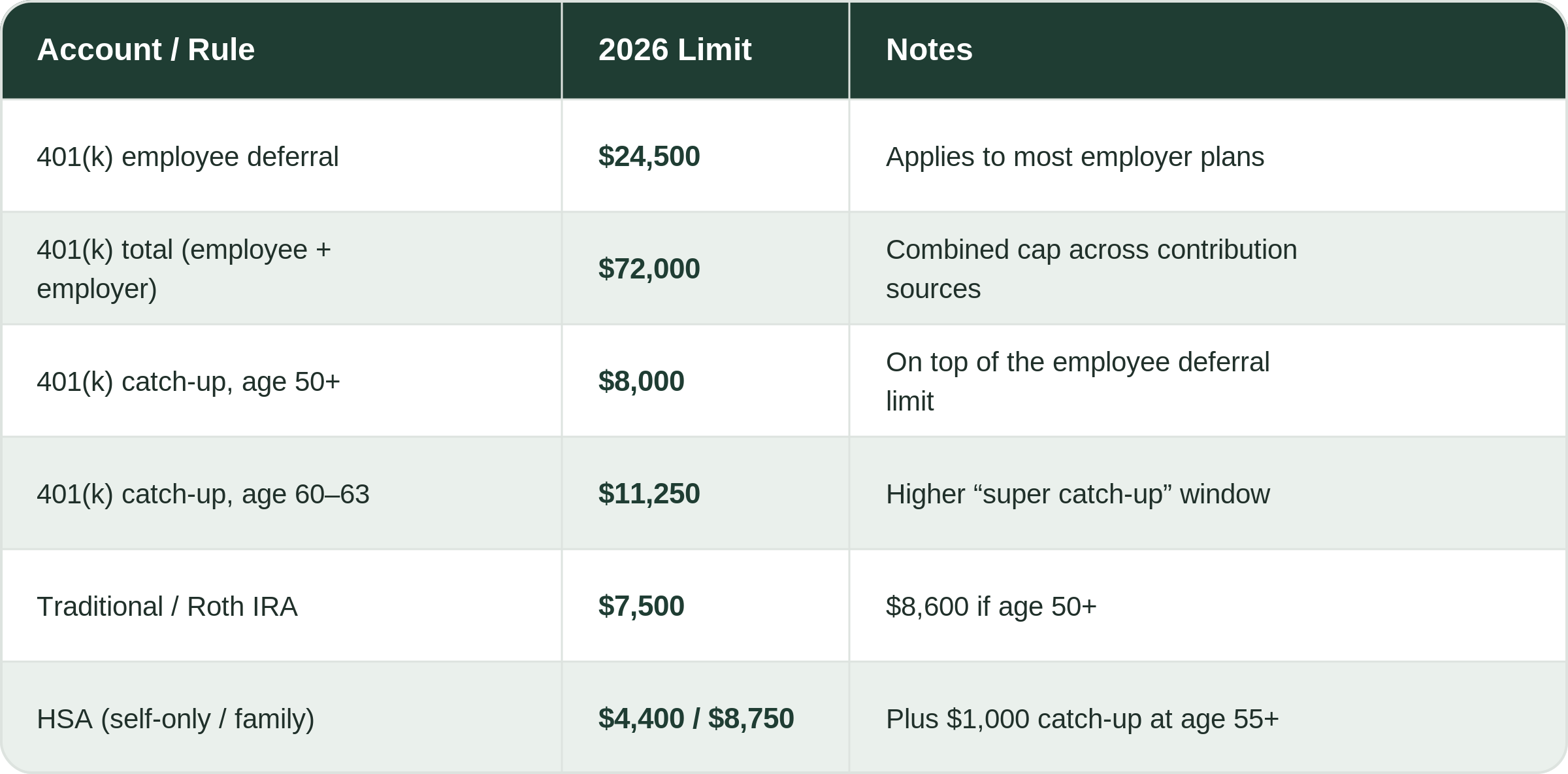
One rule worth flagging: starting in 2026, if you earned more than $150,000 in FICA wages the prior year, any age-50+ catch-up contributions to your employer plan must go in as Roth contributions rather than pre-tax. If that applies to you, it's worth confirming your plan is set up to handle it correctly.
You’ve Maxed Out Your 401(k)… Now What?
The backdoor Roth IRA. Direct Roth IRA contributions phase out at higher income levels, which rules out a lot of high earners. A "backdoor" Roth IRA is simply a two-step process: contribute to a non-deductible Traditional IRA, then convert those funds to a Roth IRA. It's a well-established strategy, but it comes with a wrinkle. The IRS "pro-rata rule" can create an unexpected tax bill if you have other pre-tax IRA money sitting around. This is a good one to walk through with a professional before you do it.
The mega backdoor Roth. Some employer 401(k) plans allow after-tax contributions beyond the standard $24,500 deferral limit, up to the overall $72,000 combined cap. If your plan allows it, those after-tax dollars can potentially be converted to Roth, letting you shovel significantly more into tax-free growth each year. Not every plan offers this feature, so the first step is simply checking your plan document or asking HR.
Don't Overlook Deferred Compensation
Nonqualified deferred compensation (NQDC) plans are common for corporate professionals in energy, oil & gas, and other high-earning industries. These plans let you defer a portion of salary or bonus into future years, often to smooth out a high-income year or bridge into retirement.
They can be a powerful tool, but they're not the same as your 401(k). A few things worth understanding before you participate:
Unlike a 401(k), the money in an NQDC plan is generally an unsecured promise from your employer, meaning it isn't held in a protected trust the way qualified plan assets are.
Distribution elections are often locked in well before you actually receive the money, so timing decisions matter.
If you leave the company before you're vested, you may forfeit some or all of the deferred amount, depending on the plan's terms. If your employer offers one of these plans, it's worth understanding the specific terms before deciding how much (if any) to defer.
Balancing Your Tax Buckets
Pre-tax accounts (ex. IRA), tax-advantaged accounts (ex. Roth IRA), and regular taxable brokerage accounts are each taxed differently. Having savings spread across more than one of these “buckets” can give you more flexibility later. The ability to choose which account to draw from based on your tax situation in any given year, rather than being locked into one outcome.
We covered this idea in more detail in Diversification in Plain English. The same logic that applies to spreading out your investments also applies to spreading out your tax exposure.
Common Mistakes We See at This Stage
Letting lifestyle creep absorb every raise, leaving retirement contributions flat even as income grows.
Holding a large concentration of employer stock or equity compensation without a plan for managing that concentration risk.
Treating bonus or variable income as “extra” spending money instead of building it into a savings plan.
Not revisiting beneficiary designations after a marriage, divorce, or new child.
Assuming “max out the 401(k)” is a complete retirement strategy on its own.
Questions to Think About When Getting Started
What does your current mix of pre-tax, Roth, and taxable savings actually look like?
Does your employer offer a mega backdoor Roth or deferred compensation option you haven't explored?
How concentrated is your net worth in employer stock or equity compensation?
Are your beneficiary designations up to date across all your accounts?
How many years do you realistically have until retirement, and does your savings rate reflect that timeline?
Important Reminders About Risk
Retirement planning doesn't eliminate investment risk, and no strategy discussed here guarantees a particular outcome. A few things to keep in mind:
Account balances can go down as well as up, depending on how underlying investments perform.
Tax laws can change. What's true about contribution limits and account taxation today may not hold in the future.
Strategies like the backdoor Roth and mega backdoor Roth involve specific IRS rules, and getting the details wrong can create an unexpected tax bill.
Contribution and income limits are updated periodically by the IRS. Always confirm current figures before acting.
A financial professional can help you look at your full picture: income, benefits, equity compensation, and goals, and figure out which of these tools make sense for you.
If you want to talk through your specific situation, we’d be happy to help. At Wealth and Plan, we work with high-earning professionals in their 30s and 40s who are navigating exactly these kinds of moments.
IMPORTANT DISCLOSURE
This post is for educational purposes only and does not constitute personalized investment, tax, or legal advice. The information presented in this article is believed to be factual and up-to-date, but we do not guarantee its accuracy and it should not be regarded as a complete analysis of the subjects discussed. Nothing in this article should be construed as personalized investment or tax advice, or as an offer to buy or sell any investment. Consult a professional advisor before implementing any of the strategies discussed. Investments involve varying degrees of risk, and there can be no assurance that any specific investment or strategy will be suitable or profitable. Income and success cannot be guaranteed. All investment strategies can result in profit or loss.