Wealth Transfer Planning 101: What High Earners Need to Know
What comes to mind when you think of “estate planning”? For some, it’s images of retirees, family trusts, and meetings with lawyers in wood-paneled offices. For most of us in our 30s and 40s, it’s two words that we know are important, but we’re too busy to think about it right now.
Let’s simplify wealth transfer planning, and discuss what’s worth focusing on today.

MY COMMITMENT TO YOU
In the world of AI, most financial education articles are written by robots, not people. This one isn’t. My name is Pijus Bulvinas, I am a CFP® professional and Founder of Wealth and Plan. I believe good financial planning starts with real conversations, and that belief carries over to our blog. Hope you find this article useful, and take it easy on me if you find a typo!
What is Estate Planning?
At its core, estate planning is simply the process of deciding who gets what you own, who makes decisions on your behalf if you can't, and how smoothly do the assets change hands when the time comes. It includes things like a will, beneficiary designations, and powers of attorney, along with any trusts you choose to use.
Wealth transfer planning is the piece of that process focused specifically on passing what you've built to the people, or causes, you care about, as intentionally as possible.
Isn’t It Just For the “Ultra-Wealthy”?
I get this question a lot.
Part of why young professionals ignore the topic altogether is because of the stigma that estate planning is expensive and only reserved for individuals and families with significant legacy assets attached to their name.
The good news is that it isn't as complicated, or as expensive, as it sounds for most people at this stage. It's less about elaborate trust structures and more about getting a handful of core documents in place, making sure they actually reflect your life today, and understanding which tools might make sense as your net worth grows.
What Are Core Estate Planning Documents?
Before going down the rabbit hole of various complex trusts, there are 3 documents that build the core of your estate plan:
Will. It names guardians for minor children and directs how assets not otherwise covered by a beneficiary designation or joint title are distributed upon your passing.
Durable Power of Attorney. This names someone to manage your finances and legal matters if you're unable to, without a court needing to get involved. The “durable” means the authority stays in effect even if you become incapacitated, which is exactly when you'd need it most.
Advanced Medical Directives. This is typically a pair of documents: one that names someone to make medical decisions on your behalf, and one that spells out your own wishes (like end-of-life care preferences) in writing, so your family isn't left with the burden if you can't communicate them yourself.
These documents are the foundation and typically enough for most young professionals. If you feel your situation is a little bit more complex, then it might be worth engaging an estate attorney to draft a trust… but which one?
What Are Trusts?
A trust is a legal arrangement that holds assets on behalf of someone else, according to rules that you set. The basic idea is simple, but the structure may become complex.
Every trust fundamentally relies on the relationship between these three essential individuals:
Grantor
Role: The creator of the trust.
Action: They transfer ownership of their physical or financial assets into the trust.
Authority: They dictate the strict rules and conditions for how those assets must be managed and eventually given away.
Trustee
Role: The legal manager of the trust.
Action: They hold legal title to the assets and handle the day-to-day administration.
Authority: They must follow the grantor's instructions exactly and have a legal duty (fiduciary duty) to act solely in the best interest of the beneficiary.
Beneficiary
Role: The recipient of the trust's wealth.
Action: They receive income, property, or other financial benefits from the trust.
Authority: They do not manage the assets directly, but they hold the equitable right to enjoy them according to the timeline set by the grantor.
Knowing that, let’s identify the two most common trust types: Revocable Trusts and Irrevocable Trusts.
What Are Revocable Trusts?
A revocable trust is one you create and can change, or even dissolve, at any time during your life. You keep full control over what's inside it, and for many people it's a useful tool for avoiding probate (the public, and sometimes lengthy, court process that oversees the distribution of your estate).
Sounds great, right? It might be, but you must practice caution. One of the biggest mistakes we see with revocable trusts is people setting one up, signing the paperwork, and never actually moving any assets into it. If not careful, it can quickly become a very expensive stack of paper without any real purpose.
Why is this important? A trust only controls what's titled in its name. If your house, investment accounts, or other assets are still sitting in your own name when you pass, the trust is just an empty folder, and your estate ends up in probate anyway. Funding the trust, the process of retitling accounts and property into it, matters just as much as creating it in the first place.
I must also point out the three essential individuals of a revocable trust:
Grantor: Typically you.
Trustee: Also you, for as long as you're alive and able.
Beneficiary: Again, you (during your lifetime). Then your heirs, family members, or charity after you pass.
Notice - you frequently wear all three hats at once with a revocable trust. This is why the IRS considers the assets to still be yours personally.
What Are Irrevocable Trusts?
An irrevocable trust works differently. Once it's created and funded, you generally can't change your mind, take the assets back, or dissolve it.
In exchange for giving up that control, assets held in an irrevocable trust are typically removed from your taxable estate, which is why they tend to come up in conversations about the federal estate and gift tax exemption once someone's net worth starts approaching those thresholds.
Most people in the wealth accumulation phase of their lives don't need an irrevocable trust just yet, but as your compensation becomes more complex, business grows, or your net worth climbs, it might be worth a conversation.
Three essential individuals of an irrevocable trust:
Grantor: Typically you.
Trustee: NOT you! The trustee of an irrevocable trust is a separate person or institution, who manages the trust and administers it according to its terms. Using an independent trustee is typically what keeps the assets out of the grantor's taxable estate.
Beneficiary: NOT you! Your heirs, family members, or charity.
Notice - an irrevocable trust separates the three roles, which is what allows it to legally become its own independent entity, entirely separate from you.
The 2026 Numbers You Should Know
Now that you know the difference between a revocable and an irrevocable trust, let's take this a step further.
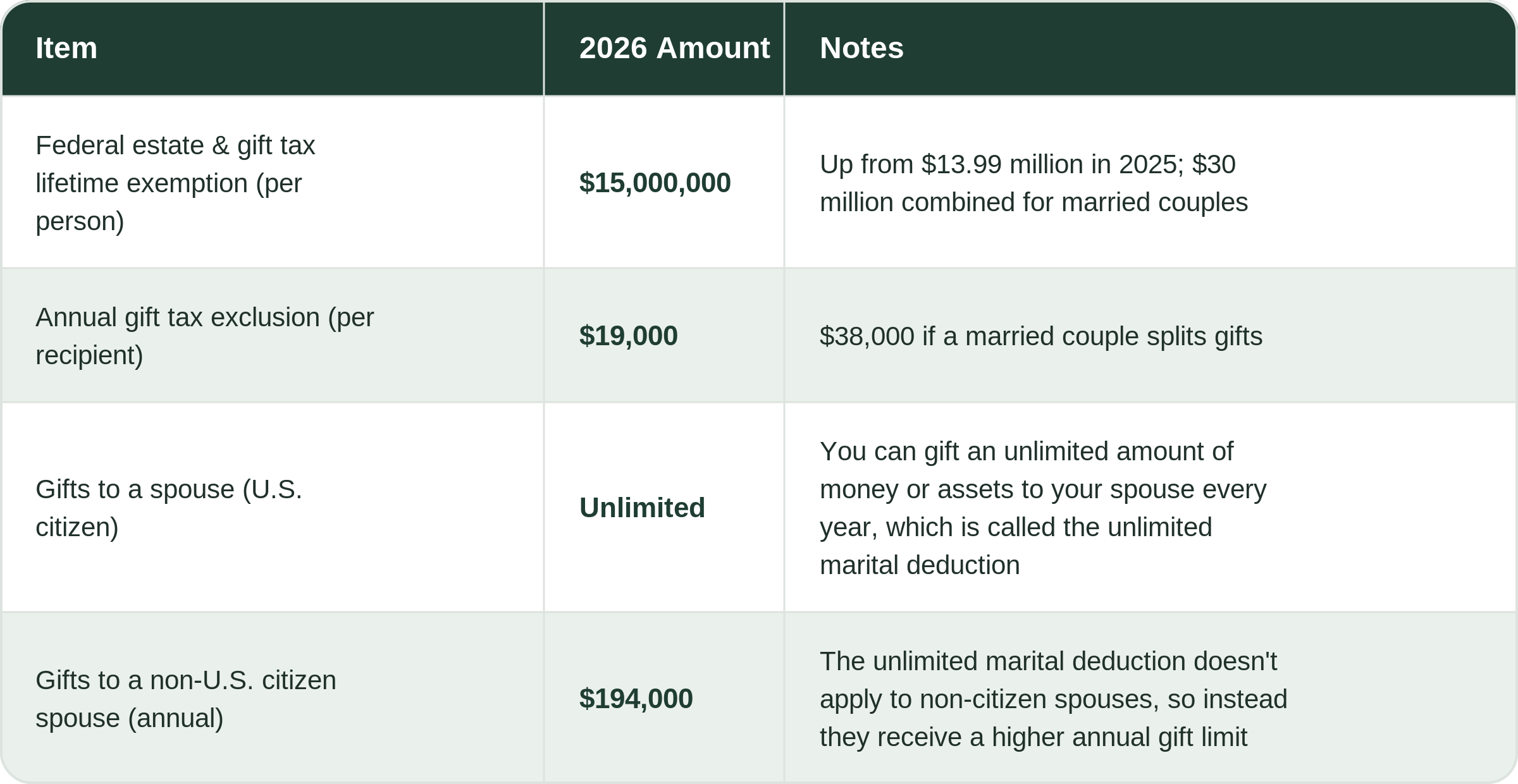
Behind almost every conversation about trusts, gifts, and inheritances sits a set of federal limits, numbers the IRS sets and adjusts nearly every year, that quietly determine how much you can give, to whom, and when the government starts paying attention.
Most people go their whole lives without bumping into them. But it's worth knowing they exist, and roughly where they stand today. Here are the limits for 2026:
What Are Common Mistakes When It Comes to Estate Planning?
I’ve tried to keep this article as simple as possible, but you might already begin to see just how complex estate planning can become. At Wealth and Plan, we periodically review your estate plan to ensure it remains in alignment with your wishes as life evolves.
Below are some common mistakes I’ve seen:
Beneficiary designations that still name an ex-spouse, or haven't been updated since a marriage, divorce, or new child.
No will at all, which means state law, not you, decides who inherits and who becomes guardian for minor children.
Revocable trust established, but no assets have been moved into the trust.
No documented plan for who can make decisions on your behalf if you're incapacitated, not just after death.
Questions to Ask Yourself
Hopefully this article has shed some light on the basics of estate planning. Below are some questions that may be worth asking as you begin to think about your estate plan:
Are your beneficiary designations in alignment with life today, not five years ago?
Who would make financial and medical decisions for you if you couldn't?
If something happened to you tomorrow, would your family know where everything is and how to easily access it?
If you own a business, do you have a continuity plan in place to wind down your operations if you were to pass away?
When did you last look at or update your estate planning documents?
If you want to talk through your specific situation, we’d be happy to help. At Wealth and Plan, we work with high-earning professionals in their 30s and 40s who are navigating exactly these kinds of moments.
IMPORTANT DISCLOSURE
This article is for educational purposes only and does not constitute personalized investment, tax, or legal advice. The information presented in this article is believed to be factual and up-to-date, but we do not guarantee its accuracy and it should not be regarded as a complete analysis of the subjects discussed. Nothing in this article should be construed as personalized investment or tax advice, or as an offer to buy or sell any investment. Consult a professional advisor before implementing any of the strategies discussed. Investments involve varying degrees of risk, and there can be no assurance that any specific investment or strategy will be suitable or profitable. Income and success cannot be guaranteed. All investment strategies can result in profit or loss.